

How Much Money Does Men's Soccer Bring In
When the U.S. women's national team and the U.S. Soccer Federation agreed to a new collective bargaining agreement back in 2017, it seemed similar a relief for both sides at the time. The USWNT's previous contract had expired months prior, and the players had considered going on strike earlier in the process but worried about how information technology could bear upon the National Women's Soccer League, which the USWNT players were obligated to play in. With a CBA finally done, information technology appeared everyone could movement on.
But that'southward not really what happened. In 2019, the players sued U.Southward. Soccer alleging gender discrimination over the compensation and other not-budgetary issues -- much of what was in the CBA they signed in 2017. The players have maintained that they asked in those negotiations for the same contract the men get, simply U.Due south. Soccer dismissed the idea outright, leaving them with no choice but to take an unequal contract so they could keep playing. The federation denies that happened, only what's clear is that the CBA the federation signed for the women in 2017 and remains in consequence today is very different from the men'south CBA -- and that has been a big problem for U.S. Soccer, both considering of the bad publicity it has generated and because of the equal pay lawsuit that is still working its style through the legal system.
With the USWNT'due south CBA set to expire on March 31 after agreeing to a three-month extension, and USMNT still operating on a CBA that technically expired on Dec. 31, 2018, both sides are negotiating for new contracts.
Whether the USWNT and the USMNT are willing to accept a joint contract -- and it appears for now they are not -- it's clear there are enough of differences to reconcile to eliminate the big disparities in the current deals. To brand the two teams' contracts more similar, who benefits and who loses out?
Two different contract structures
Every CBA for either team is traditionally built on previous CBAs, and the side by side ones volition be no dissimilar. While there are a lot of means the current contracts between the USWNT and the USMNT are similar, each team prioritized different things when negotiating, resulting in unlike deals overall.
The USWNT players, for example, surprised U.S. Soccer negotiators in 2017 when they announced they would have control of the licensing and sponsorship rights that U.S. Soccer had controlled in previous CBAs. The players felt U.S. Soccer wasn't maximizing their marketability, and then the USWNT launched its own commercial arm, signing licensing deals and collecting royalties without U.S. Soccer's involvement. In the USMNT's CBA, still, the men continued to permit U.S. Soccer sign such deals on the players' behalf, with the revenue split up between the federation and the USMNT.
The men's CBA too makes no mention of health insurance, unlike the women's CBA, which guarantees information technology. The federation often cites this in arguing the women become better perks, but in actuality, the women get health insurance through the U.S. Olympic Committee since the women are considered Olympic athletes and the men aren't, per FIFA rules. U.South. Soccer only pays the taxes for that wellness insurance, as stipulated in the CBA, and it's only worth almost $1,500 per year per player.
At the same time, both teams have substantially the same language around hotel accommodations: The teams and the federation produce a shortlist of preferred hotels in given geographic locations, which the federation is supposed to cull from. If the federation doesn't choose from the list, it "will explain its rationale to the Players Association," co-ordinate to the linguistic communication in both contracts.
The biggest difference between the ii contracts -- and the one that has caused the most tension -- is how the players get paid. Some of the players on the women's team get salaries, regardless of games played, but no players on the men's team exercise.
Kickoff, it'due south important to understand why this big difference exists. Twelvemonth-circular salaries were beginning introduced by U.S. Soccer for the USWNT in their 2005 CBA, when women's national team had very few order options: They faced the choice of playing soccer for their state with no financial stability, or getting other jobs to earn a better living. Working an office job and playing soccer wasn't viable: When monthlong tournaments came around, like a World Loving cup, players usually had to quit their jobs or be fired.
Every USWNT contract since 2005 has been congenital upon that bones salary structure, but in their last CBA, the USWNT players took a stride away from it. The number of players eligible for salaries went down over the life of the contract, while the number of non-salaried players who rely exclusively on call-up fees, roster advent fees and operation bonuses increased. Salaried players earn $100,000 per year, regardless of playing in games, while non-salaried players earn between $3,250 and $four,500 per game, depending on the year of the contract and the "tier" of the player.
Players on the USMNT, meanwhile, are paid only based on call-ups, game appearances and performance bonuses. A player earns $five,000 for making a game roster, which means that for a typical 23-player roster, U.S. Soccer sets bated $115,000 per game every bit base pay.
In other words, U.Due south. Soccer does set aside a guaranteed pot of money for the men, but just if they play games. If not for the USMNT declining to qualify for the 2018 World Cup or the pandemic, the USMNT probably would've played more games in 2018 and 2020, which would've meant more game-appearance fees and a much higher base pay for the USMNT over those years.
When U.S. Soccer says information technology has offered the USWNT the same contract structure that the USMNT has -- something neither side disputes -- it ways that it offered to eliminate salaries for the women and provide the per-game fee and bonus structure. But what the USWNT has argued, both in the court of public opinion and in legal filings, is that U.Southward. Soccer never offered the same dollar amounts for such performance bonuses.
Performance bonus pay gap
Most games that either team plays in a given calendar year have traditionally been friendly games, even in years with a major tournament. The men'south calendar is condign more congested with the new CONCACAF Nations League on tiptop of the Gold Cup and World Loving cup qualifying, making less room for friendlies, but the COVID-19 pandemic has exacerbated that tendency by forcing important games to be squeezed into fewer international windows. Due to fewer international tournaments on the women's calendar, the USWNT plays more friendlies, but either mode, friendly bonuses effigy to be a major source of income for both teams going forward.
Both teams construction their friendly bonuses in a similar fashion. They each set three tiers of opponents -- for the women, the top opponents are ranked 1-iv in FIFA'southward world rankings and one-10 for the men, which reflects the greater number of competitive teams on the men's side. Mid-tier opponents are v-viii for the women and 11-25 for the men, with the lesser tier consisting of all teams after that. Both the USMNT and USWNT receive top bonuses for beating their biggest rivals: Canada for the women and Mexico for the men.
The top end and low end of the bonuses are both significantly higher for the men. The highest friendly bonus for the men, $17,625 for beating a top-tier team, is more double the women's highest bonus, $viii,500 for beating a top-tier team. The men each become a bonus of $half-dozen,250 just for tying a bottom-tier team, while the women get $0 for the same thing.
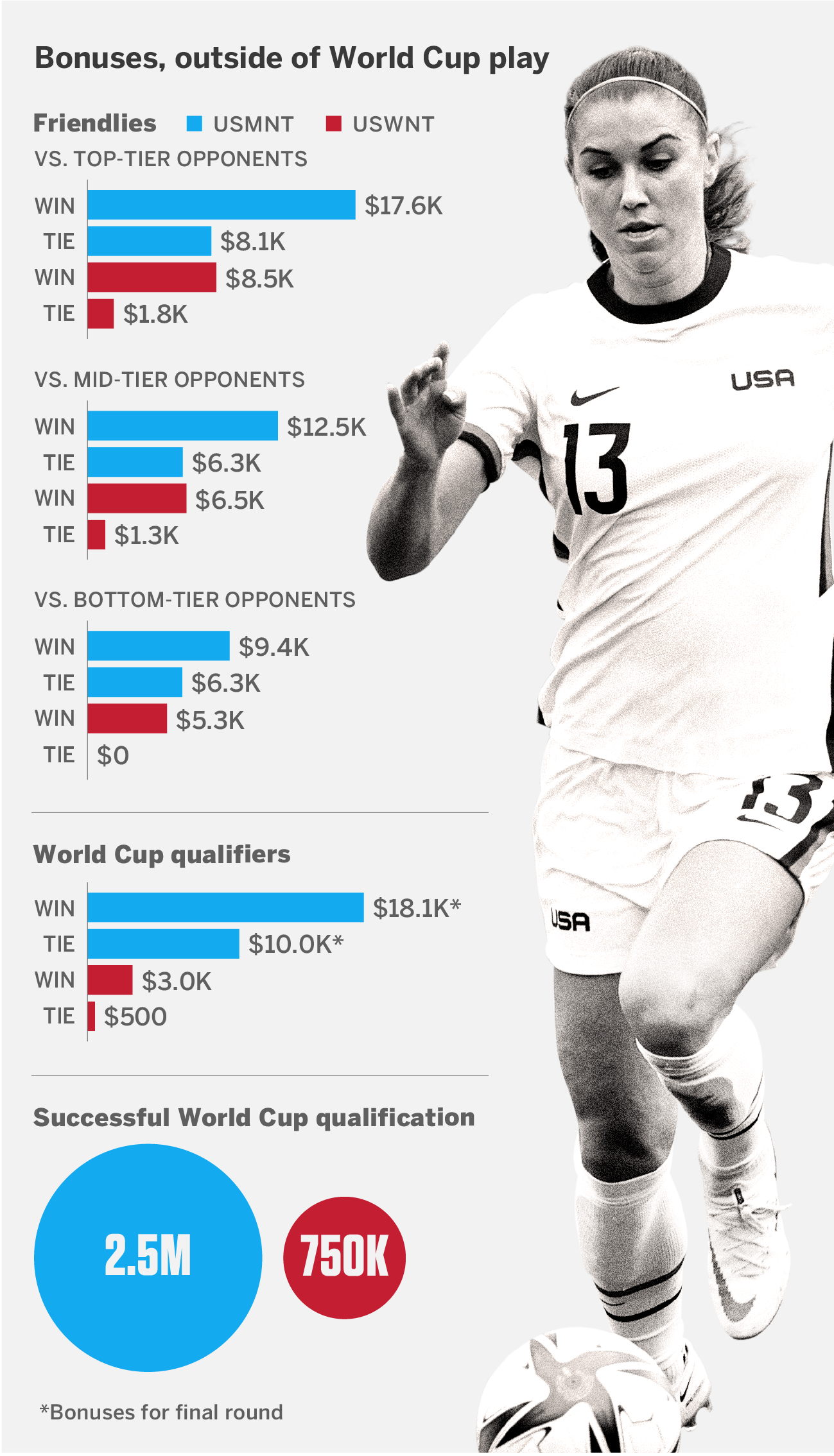
Each team is too entitled to exclusive bonuses considering the two teams don't play in the same tournaments. For instance, the USWNT tin can earn $500,000 as a team for qualifying for the Olympics, although information technology doesn't become any bonuses for winning individual Olympic qualifying games. If information technology wins a golden medal, that's worth a $100,000 bonus per histrion, while silvery is $55,000 and bronze is $25,000. Since the senior men's team doesn't compete in the Olympics -- the men's tournament is limited to U-23 teams, with three overage exceptions, to avoid conflict with the FIFA World Loving cup -- no such bonuses exist in its contract.
The men do, however, get bonuses for competing in the CONCACAF Gold Cup. Winning games during the tournament can exist worth as much as $17,625 per player, and winning the Gilt Loving cup is worth $11,250 per player. The women compete in a CONCACAF Gilded Loving cup, likewise, but they aren't entitled to private game bonuses for the tournament unless it doubles as the qualifying tournament for the World Loving cup.
The widening World Loving cup split
For all the differences in the USWNT and USMNT contracts, the bonuses offered for Earth Cup performances are where the carve up becomes the starkest, and it'southward no surprise that much of the USWNT's ongoing equal pay lawsuit focuses on these numbers.
The tone is set during World Cup qualifying, when the men earn $2.5 million as a squad for qualifying and the women earn only $750,000 for the same thing. During World Cup qualifiers, the men tin can earn up to $18,125 per histrion in the final circular for each win, but the women get only $3,000 per player for each win.
Merely it's one time the tournament begins when the largest gaps sally. While the women start cashing in if they finish in third place ($575,000 for the team) and they can share $two.53 1000000 if they win the whole thing, the men collect handsome rewards for every stage of the tournament before the last. Reaching the round of 16 alone is worth $iv.5 meg for the USMNT, the quarterfinal circular is worth $5 1000000, and the semifinal is $5.625 one thousand thousand. That'southward all before the $9.375 million bonus in the USMNT's contract with U.Southward. Soccer if they win the World Loving cup.
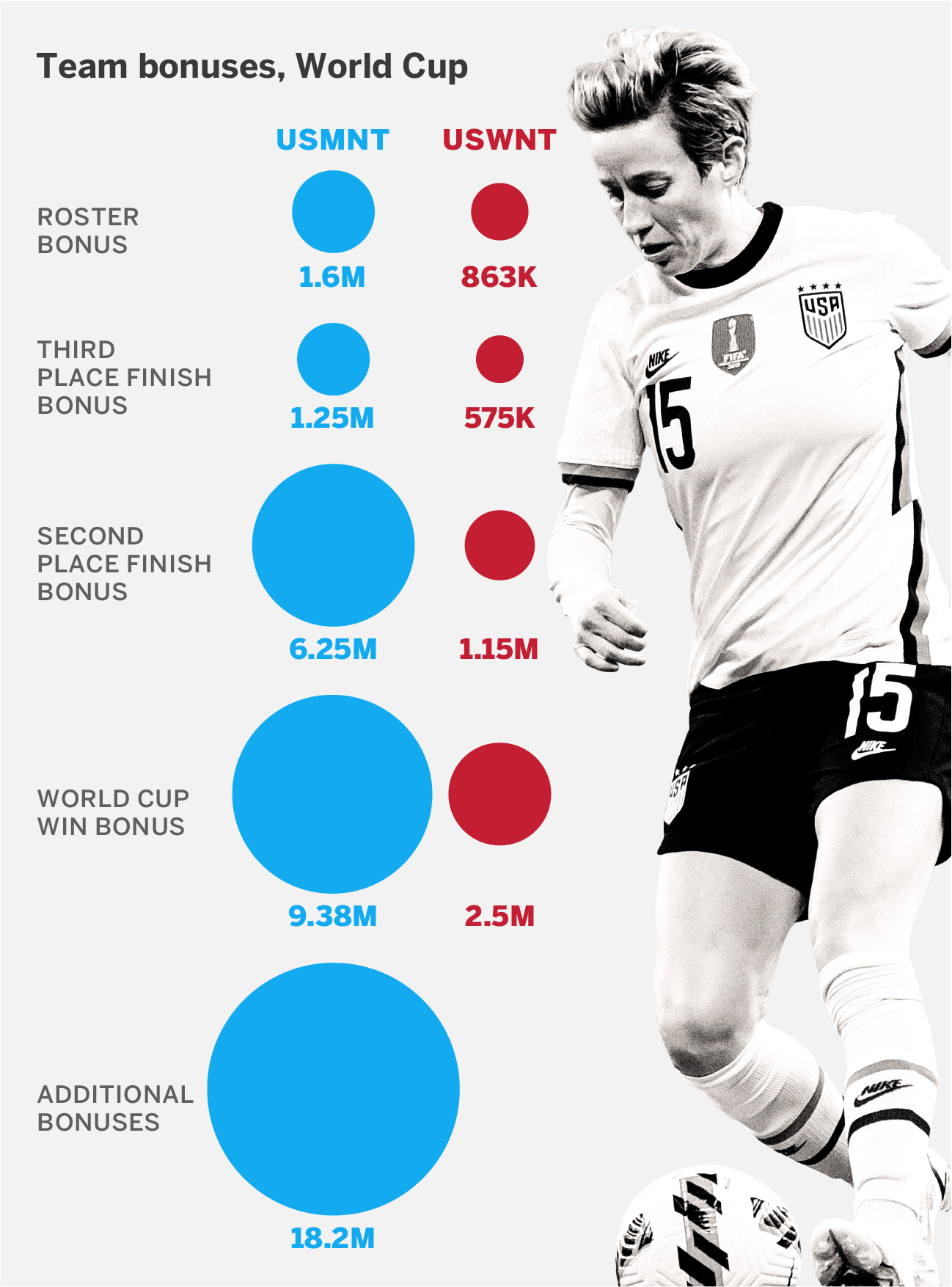
Information technology's impossible to look at World Cup bonuses without examining the prize money from FIFA, the governing torso of global soccer and the organizer of World Cups. Fifty-fifty though U.S. Soccer sets its own World Loving cup bonuses, FIFA prize coin looms in the background.
In the last World Cup cycle, FIFA offered a prize of $38 million to the team that won the men's World Cup in 2018 (France), and merely $4 million to the team that won the women's tournament in 2019 (the USWNT). In all, FIFA offered a total of $400 million for the men'south World Cup and just $xxx 1000000 for the women's tournament.
(There is a popular bit of misinformation for why this discrepancy exists: a fake number has circulated claiming that the Women's World Loving cup brings in $131 one thousand thousand in revenue for FIFA while the men's Globe Cup brings in $half dozen billion. This is faux, and FIFA itself has confirmed it because FIFA sells sponsorships and broadcast rights for all of its World Cup events equally a unmarried package, making Women'southward World Cup acquirement unknowable. Why FIFA refuses to offering equal prize money -- it has recently widened the gap rather than narrowing it -- is unclear, merely it's also irrelevant for the purpose of U.S. Soccer negotiating CBAs with its national teams because U.S. Soccer can't control that.)
U.Due south. Soccer likes to blame FIFA for the size of the Globe Cup bonuses in the USWNT's contract, but information technology's worth noting something of import: U.S. Soccer has never opted to base its bonuses for the USWNT or the USMNT directly on FIFA prize money. The bonuses in their current contracts are non a percentage of FIFA's payouts. Instead, U.S. Soccer has chosen its own bonuses to offer both teams, which sometimes deviate from FIFA's prize money.
For case, in U.S. Soccer's CBA with the USMNT, the men get $218,750 per indicate won in the grouping stage of a Globe Cup, with a maximum payout of $ane,968,750. This is a bonus U.S. Soccer concocted -- it has no straight correlation to FIFA prize money, which is awarded based on which round of the tournament that teams achieve.
Under the current USMNT and USWNT contracts, if FIFA stopped offer prize coin for World Cups altogether, the federation would however owe the millions of dollars promised if the teams won. By the same token -- and what U.S. Soccer was likely expecting -- if FIFA's prize money drastically increased, U.S. Soccer wouldn't accept to pay all of information technology out to the teams and could pocket the actress.
This where the probability of each teams' success at a World Loving cup comes into play.
Former U.S. Soccer president Sunil Gulati, on a conference call after the USWNT filed an initial wage discrimination complaint with the Equal Employment Opportunity Commission in 2016, was asked whether the women "deserve to be paid equally" to the men'south team. In his answer, he said a lot of factors go into how the players are paid, including "the rails record of teams" and "incentives." By Gulati's access, it was easier to offering the men peak-end bonuses that U.S. Soccer believed it would probably never accept to pay.
Historically, whatever World Cup bonuses U.Due south. Soccer offered the men beyond a certain point were equally good equally Monopoly coin -- there was almost no chance the men would collect the bonuses. Each team's tape in the four Earth Cup cycles before the teams negotiated each of their electric current contracts made that clear, and neither squad could've predicted it during negotiations, but the men wouldn't even end up qualifying for the 2018 World Cup.
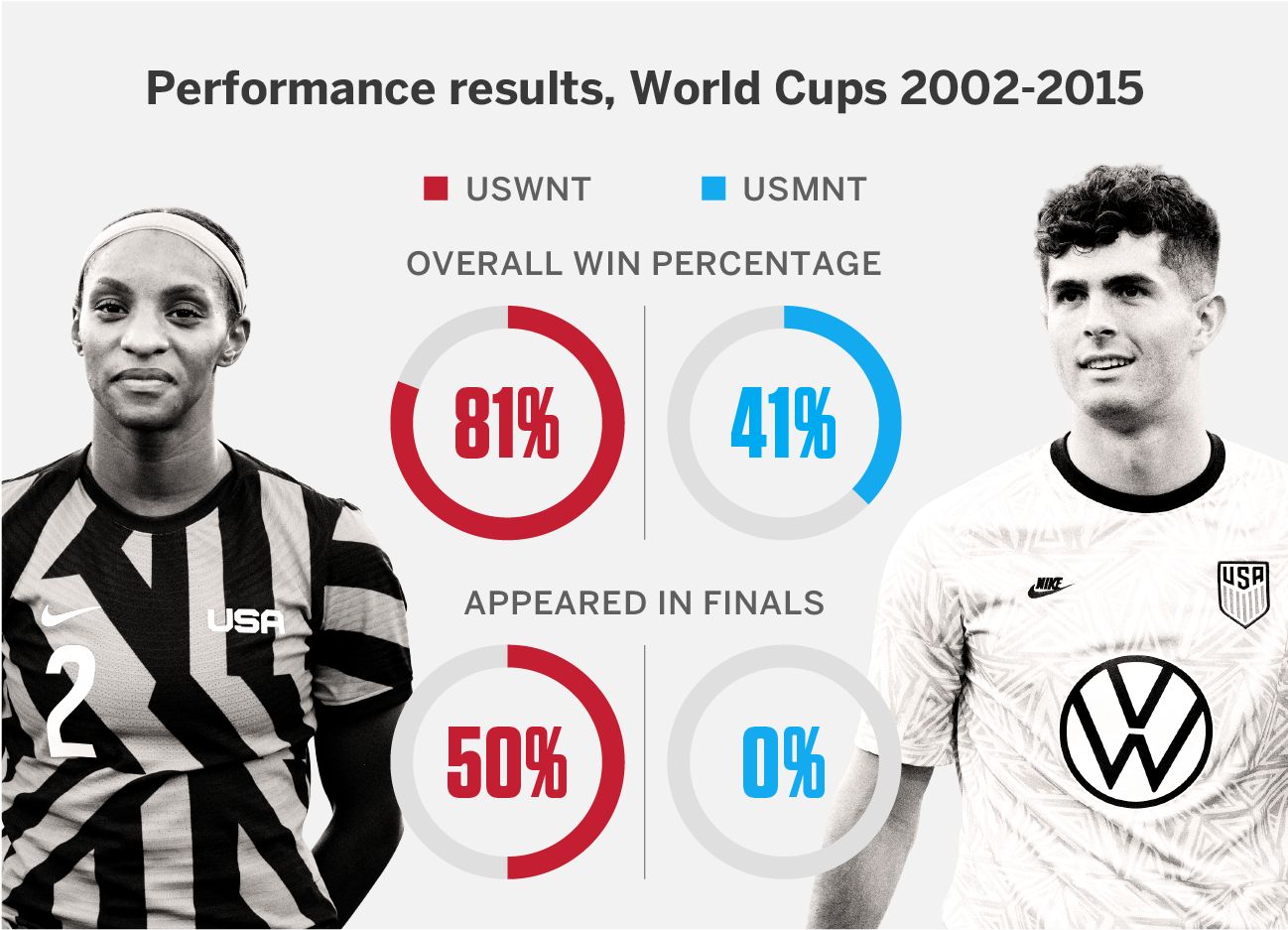
Capturing the peak of the upside
Performance bonuses can reward players for their on-field success, but what about when on-field success translates into unprecedented commercial success? When the USWNT won the Globe Cup in 2015, their contract didn't allow them to reap any extra rewards.
When three-star USWNT jerseys were flight off the shelves, that coin didn't get to the players. When the USWNT set up an attendance record for a standalone friendly half-dozen weeks subsequently the World Loving cup, drawing more than 44,000 people to Heinz Field in Pittsburgh, they still got the same modest cut of ticket sales. The USWNT was more popular than e'er, and U.Due south. Soccer ended upward with a $17 meg windfall thanks to it, simply the players did not.
"I thought it was bulls---," then-USWNT defender Meghan Klingenberg later on explained. "All these people are making money from our likeness and our faces and our value, but we're not. We're merely getting coin from our winnings, and that doesn't seem right."
The USWNT was unable to cash in on the peak of its popularity at the time, and information technology prompted the team to change two things in its current CBA when it negotiated information technology in 2017. The showtime was taking control of the epitome rights to launch its own licensing program, and so players' names and likenesses could be featured on everything from socks to NFTs with the players getting a cut. The second was the addition of provisions designed to capture the upside of unprecedented growth.
Both the USWNT and the USMNT get $one.50 from each ticket sold for U.S. Soccer-hosted games, but now the USWNT players go boost from brisk sales. Later 17,000 tickets are sold, they get an actress seven.5% per average ticket price, and a $15,000 bonus when games sell out. Although U.S. Soccer and Soccer United Marketing are dissolving their partnership next year, SUM has been responsible for selling broadcast rights for national squad games, as well as sponsorships for the teams, and the USWNT wanted a cut when SUM performed ameliorate than expected, too. That came in the course of a bonus: whenever SUM generated more than $26.5 million in gross acquirement each year, the USWNT would get ten% of it.
The USMNT has never concerned itself with capturing that kind of upside considering, in part, the USMNT has never experienced an explosion in popularity the aforementioned manner the USWNT has. But now as the teams work on new contracts that volition be more than like than in the past, the question volition be: Which parts of each contract should exist kept, and which parts shouldn't? The teams' current CBAs are the starting point for negotiations and will ultimately assist decide what their new CBAs will ultimately look similar.
The USWNT has until March 31, the new expiration appointment on their current CBA, to figure it all out. If non, the CBA will roll over and they will play on an expired contract -- but they would no longer be bound by their CBA'south no-strike clause. The men'south team, meanwhile, will keep to play on their years-expired contract until they sign a new bargain with the federation and, only as they about did final twelvemonth, they can proceed strike at any fourth dimension.
Source: https://www.espn.com/soccer/united-states-usaw/story/4589310/uswntusmnt-pay-gap-explained-comparing-their-us-soccer-contracts-as-both-sides-negotiate-new-cbas
Posted by: hobsoncond1972.blogspot.com
0 Response to "How Much Money Does Men's Soccer Bring In"
Post a Comment